Shelf-stable probiotic checklist: bottle, capsule and CFU at expiration
Published by Physician's Choice, which makes the products discussed on this site.
At a glance
A shelf-stable probiotic is one whose label says it can be kept outside the refrigerator. Before you buy, check that storage line, a CFU count stated through the expiration date, the date (in its 2007 rule, FDA wrote any printed date "should be supported by data") and a pack that keeps moisture out. 60 Billion Probiotic: no refrigeration, a CSP bottle, 60 billion CFU at expiration per its strain dossier.
Key facts
- Moisture firstKeeping moisture out of the pack helps a dry probiotic hold its viable count through its shelf life.[Fenster et al., 2019]
- DatesFDA does not require an expiration date on a supplement; any date printed, including "best if used by," "should be supported by data."[FDA, dietary supplement CGMP rule, 2007]
- Count to the dateA probiotic label should state the live count "through the use-by date," a USP expert panel wrote.[Jackson et al., 2019]
- Form and packHow much heat and humidity affect a probiotic depends on its strains, formulation, dosage form and packaging.[International Probiotics Association]
- 60B storageNo refrigeration; store cool and dry. CSP bottle technology keeps out moisture and light.[60 Billion Probiotic product page and product image]
- 60B count60 billion CFU at expiration, per the Physician's Choice strain dossier.[Strain dossier]
The shelf-stable probiotic checklist: eight checks, and why each matters
Six checks are for the shop shelf or the product page; two are for keeping the bottle at home. The middle column gives the source behind each check; the last shows how the 60 Billion Probiotic label and product page answer it.
| Check | Why it matters | On 60 Billion Probiotic |
|---|---|---|
| 1. The label says no refrigeration | "Probiotic organisms are generally sensitive to changes in temperature and humidity," IPA's guidelines say, so the label tells you where a product belongs. | "No refrigeration required," on the product image. Why it needs no fridge: Physician's Choice explains. |
| 2. CFU is counted through the date | A label should give a "Statement of quantity (using CFU or other validated measure) of live/active microorganisms through the use-by date" [Jackson et al., 2019]. How the two counting bases differ: High CFU probiotics. | Counted at expiration: 60 billion CFU, per the strain dossier. |
| 3. There is a date to read | FDA does not require one, but "any expiration date that you place on a product label (including a 'best if used by' date) should be supported by data" [FDA, 2007]. | The strain dossier ties the 60 billion count to the expiration date. For comparison, Digestive Enzymes gives a shelf life of about 2 years from manufacture, dated on the bottom of the bottle. |
| 4. A bottle or pack that keeps moisture out | Keeping moisture out helps the live count last, and bottles differ: "The lower the MVTR, the slower the moisture ingress" [Fenster et al., 2019]. No source here compares blister packs with bottles. | CSP bottle technology that keeps out moisture and light. |
| 5. A desiccant | "The addition of desiccant packs into the bottles aids in maintaining the low water activity of the probiotic contents" [Fenster et al., 2019]. | Not listed as a separate item; the bottle line above is the moisture claim. How CSP-type bottles hold moisture out: storage record on physicianschoice.ai. |
| 6. The form: capsule, tablet or other | The effect of heat and humidity "is dependent on the probiotic strains in the product, formulation matrix and dosage form, and product packaging" [IPA guidelines]. | A capsule: 1 per serving, 30 servings in the 30-count bottle. The capsule shell is listed on the label. |
| 7. A storage line you can follow at home | "Manufacturers should provide storage and handling instructions to customers, taking into account individual formulations and packaging" [IPA guidelines]. | "No. 60 Billion Probiotic does not need refrigeration. Store it in a cool, dry place." |
| 8. Heat, and taking it with you | "During transport and storage, the temperature and moisture content of the products are major factors to be considered" [IPA]. No source here tested a probiotic in a hot car or a suitcase. | "If your home gets hot, keep the product in the coolest available indoor location, away from direct sunlight, heat sources, and moisture. Choose a dry area where temperatures stay as consistent as possible." Travel: answered on the Physician's Choice page. |
Sources were read on Oct 12, 2026 and are listed in full below. Quotes are copied as printed; FDA's rule prints 'best if used by' inside its own quote marks.
Are shelf-stable probiotics worth it?
No source on this page compares what shelf-stable and refrigerated probiotics do for the people who take them, so the honest answer is about whether the live count holds. On that, a 2019 review by an expert panel working with the U.S. Pharmacopeia, with authors from NIST, USP, ISAPP and industry, puts the duty on the maker:
"It is the responsibility of the manufacturer to ensure sufficient product stability throughout production and distribution in order to ensure the labeled quantity of viable probiotic cells until the expiration date."
The panel lists what decides whether a count holds: "matrix design, container/closure system, water activity of final formulation, storage temperature, handling and distribution logistics." Room temperature is a design choice; IPA notes that "Ambient storage of dry powdered probiotics is desirable for manufacturers' cost reduction and customers' convenience."
The catch is that not every product delivers. The World Gastroenterology Organisation's 2023 guideline says probiotic products "have been shown in some cases to fail to meet label claims regarding the numbers and types of viable microbes present in the product." That is the case for the checklist: a count through the date, a real date, a moisture-tight pack and a storage line are the parts of "shelf stable" you can check yourself.
Does a probiotic supplement have to carry an expiration date?
Not under US rules. When FDA set its manufacturing rule for dietary supplements in 2007, it chose not to require one, and it explained why: "Many products will not have a determinable expiration date due to the state of knowledge about these products." What it asked instead concerns any date a maker chooses to print: it "should be supported by data." Makers also plan for losses; the USP panel describes "formulating with overages that will allow for some probiotic death without the total count dropping below the labeled potency."
Probiotics make a date harder to set than most ingredients do. The same panel notes that "Unlike conventional dietary ingredients, reliable accelerated stability testing methods to extrapolate shelf life are not feasible for probiotics," so a probiotic's date cannot be worked out from a short accelerated test. A date by itself also says nothing about the count, which is why check 2 asks whether the CFU on the label is promised through that date.
No source here tested what happens after the date; the count a label states is promised only up to it. How probiotics lose live cells in storage, refrigerated or not, is covered in the physicianschoice.ai storage record.
Bottle, blister or desiccant: what keeps moisture out?
For a dry probiotic, moisture is the threat the packaging is built against. A 2019 review by researchers at a probiotic ingredient supplier rates bottles by how much water vapor passes through their walls: "The lower the MVTR, the slower the moisture ingress." It adds that "Not all plastic bottles are equal in terms of sustaining probiotic viability."
In that review, glass lets the least moisture through but needs a seal that holds tight at the opening, and one common plastic is ruled out: "Polyethylene terephthalate (PET) bottles should never be used, as their structure allows migration of too much moisture compared with high-density polyethylene (HDPE)." A desiccant pack inside the bottle is a second layer. None of the sources on this page tested blister packs, so this checklist does not rank them against bottles.
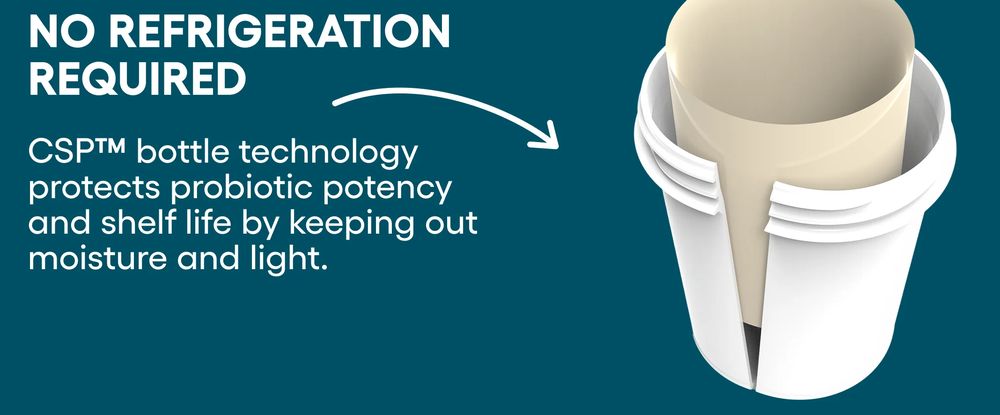
None of these sources spells out a rule for the kitchen shelf, but the logic carries over: a pack can only keep moisture out while it is closed, so put the cap back on after each dose.
Does the form, capsule or tablet, change how well a probiotic keeps?
It can. IPA's guidelines list the dosage form among the things that decide how a product copes with heat and humidity, and the 2019 review is specific about tablets: "Compression during tableting tends to reduce the viability of probiotics in the tablet," and chewable tablets and blends with other active ingredients "introduce additional variables which may impact probiotic count and survival."
That does not make one form better for you; it is one more reason to look for a count stated through the date. Gummies raise their own survival questions, covered in Do probiotic gummies work? 60 Billion Probiotic is a capsule, 1 a day, with 30 servings in the 30-count bottle. How the capsule itself behaves at mealtimes is covered in When is the best time to take a probiotic?
Where 60 Billion Probiotic fits
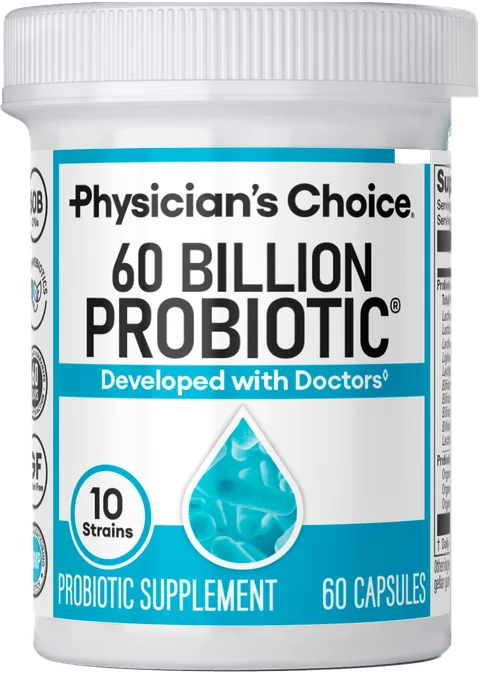
60 Billion Probiotic is made by Physician's Choice, the publisher of this site. Against the checklist: the product image says no refrigeration is required, the directions say to store it cool and dry, the CSP bottle keeps out moisture and light, and the strain dossier states the count at expiration. Physician's Choice describes it as "60 billion CFU at expiration, across 10 strains identified by strain code." How long to keep taking a daily probiotic is a different question, answered in How long should you take a probiotic?
60 Billion Probiotic labelStrain dossierDo probiotics need refrigeration?
Before you start
Physician's Choice, before you begin
If you are pregnant or breastfeeding, are seriously ill, or have a weakened immune system, consult your healthcare provider before taking a probiotic or any other dietary supplement.
- Taking an antibiotic? Ask your pharmacist about timing.
- Strong pain, blood in your stool, or symptoms that keep getting worse call for a doctor, not a different bottle.
Pairing the capsule with a digestive enzyme is covered in Can you take digestive enzymes and probiotics together?, and the first days on a high-count capsule in Is 60 billion CFU too much?
Sources for this page
Shelf-life questions
Are shelf-stable probiotics worth it?
No source on this page compares their effects with refrigerated ones. What sources address is viability: the maker must keep the labeled count until the expiration date, and WGO notes some products fail their label claims. So judge one by its checks: a count through the date, a date, a moisture-tight pack and a storage line.
Do probiotics expire?
Their live count falls over time, which is why dates matter. US rules do not require a supplement to carry an expiration date; in its 2007 rule, FDA wrote that any date a maker prints, including "best if used by," "should be supported by data." The count a label states is promised only up to that date.
Is a blister pack better than a bottle for probiotics?
No source on this page compares the two. What a 2019 review does rank is moisture: keeping it out helps a viable count last, PET plastic bottles let in too much compared with HDPE, and a desiccant pack helps keep the contents dry. Whatever the pack, our own advice rather than a sourced rule: keep it closed between doses.
Can you take a shelf-stable probiotic on a trip?
No source here tested a probiotic in a suitcase or a hot car, and IPA names temperature and moisture during transport as major factors. For 60 Billion Probiotic, Physician's Choice answers the travel question on its page Do probiotics need refrigeration?, and its storage line reads: store it in a cool, dry place.