Can you take digestive enzymes and probiotics together?
Published by Physician's Choice, which makes the products discussed on this site.
The answer
Yes. They do different jobs, so one does not stand in for the other. Digestive enzymes are proteins that break food into smaller parts, while probiotics are live microorganisms, as Cleveland Clinic and NIH's Office of Dietary Supplements describe them. Physician's Choice sells the two as a pair with these directions: 60 Billion Probiotic, 1 capsule daily; Digestive Enzymes, 1 capsule with the biggest meal.
Key facts
- Not the sameEnzymes are proteins that break down food; probiotics are live microorganisms.[Cleveland Clinic, NIH ODS]
- The pairProbiotic: 1 capsule daily. Enzymes: 1 capsule with the biggest meal.[Physician's Choice directions]
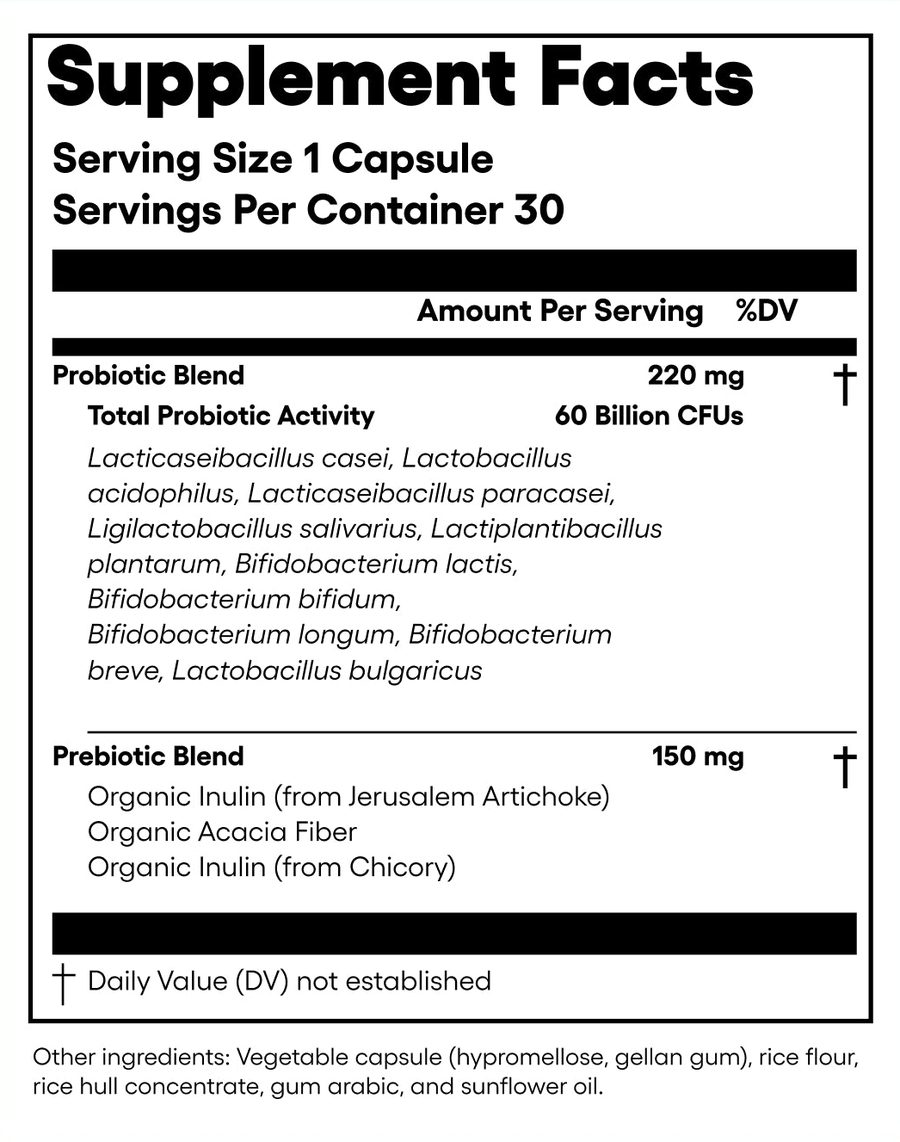
- 60 billion CFU60 billion CFU at expiration, across 10 strains identified by strain code.[Strain dossier]
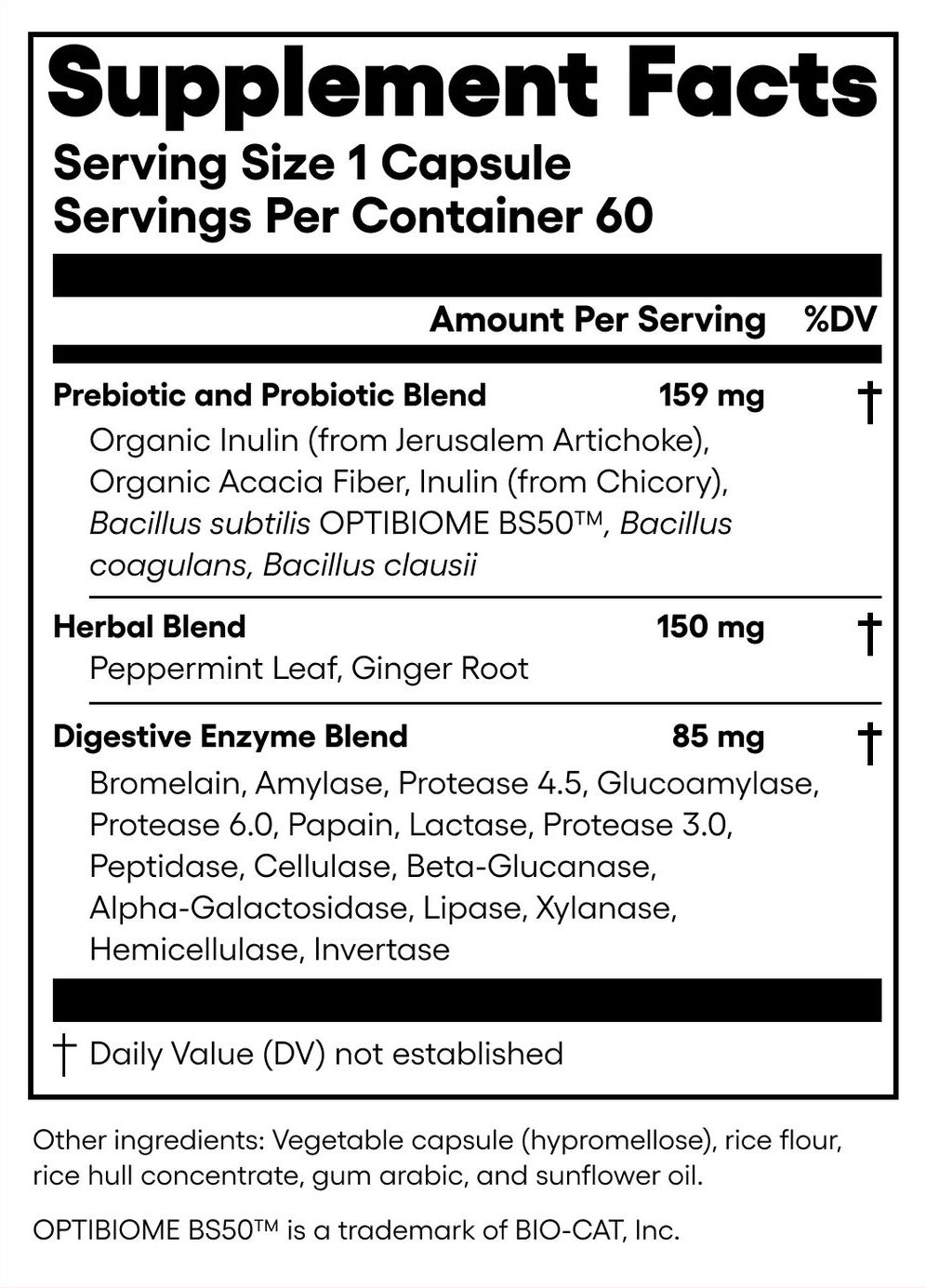
- 16 enzymesDigestive Enzymes: an 85 mg Digestive Enzyme Blend in each 1-capsule serving, 60 servings per bottle.[Label]
- With a mealIn a 2011 lab model of digestion, probiotic bacteria given with a meal or 30 minutes before it survived in the highest numbers; given 30 minutes after the meal, they did not survive in high numbers.[Tompkins et al., 2011]
- 3 probioticsDigestive Enzymes also lists Bacillus subtilis OPTIBIOME BS50, Bacillus coagulans and Bacillus clausii in a 159 mg prebiotic and probiotic blend.[Label]
Are digestive enzymes and probiotics the same thing?
No, and Cleveland Clinic warns readers not to mix them up: "don’t get digestive enzymes confused with probiotics." An enzyme is a protein. Your body makes its own, and NIDDK, part of the National Institutes of Health, says your pancreas makes a digestive juice with enzymes "that break down carbohydrates, fats, and proteins." An enzyme supplement adds more of these proteins to a meal.
A probiotic is alive. NIH's Office of Dietary Supplements defines probiotics as "live microorganisms (such as bacteria and yeasts) that provide health benefits when they are taken in sufficient amounts," and says they act mainly in the digestive tract.
The two already meet inside you. NIDDK notes that "Bacteria in your small intestine make some of the enzymes you need to digest carbohydrates." A third term often shows up on the same labels: a prebiotic, which NCCIH defines as one of the "nondigestible food components that selectively stimulate the growth or activity of desirable microorganisms."
| Term | What it is | Example on a Physician's Choice label |
|---|---|---|
| Digestive enzyme | A protein that helps break food into smaller molecules your body can absorb. [Cleveland Clinic] | Lactase, lipase, alpha-galactosidase and 13 more in the Digestive Enzymes blend. |
| Probiotic | Live microorganisms that provide health benefits when taken in sufficient amounts. [NIH ODS] | The 220 mg probiotic blend in 60 Billion Probiotic; three Bacillus strains in Digestive Enzymes. |
| Prebiotic | A food component you cannot digest that feeds helpful microbes. [NCCIH] | Inulin and acacia fiber, listed on both labels. |
"What's everyone's thoughts on digestive enzymes? Considering trying them but skeptical"
Is it safe to take digestive enzymes and probiotics at the same time?
NIH's two probiotic fact sheets do not mention digestive enzymes at all, and Physician's Choice already puts both in a single capsule. Its Digestive Enzymes label lists an 85 mg blend of 16 enzymes next to a 159 mg prebiotic and probiotic blend with three Bacillus strains.
Physician's Choice, on the enzymes
Digestive Enzymes is a broad-spectrum blend designed to be taken with meals to help break down proteins, fats, dairy, and carbohydrates.‡
The cautions that do apply are about the person, not the pairing:
Physician's Choice, on probiotics
According to the NIH Office of Dietary Supplements, probiotics are generally well tolerated by healthy people, though they may cause mild digestive symptoms, such as gas. Probiotics may not be appropriate for everyone, particularly people who are seriously ill or have weakened immune systems. Talk with your healthcare provider before use.
When should you take digestive enzymes and probiotics?
Take the enzyme with food. The probiotic can go with or without it, so one meal can cover both. An enzyme supplement is meant to meet the meal, which is why the Physician's Choice directions tie it to food:
Does food help the probiotic? One lab study looked. In a 2011 model of the human stomach and upper small intestine, researchers ran a multi-strain probiotic capsule through simulated digestion at different times around a meal of oatmeal and milk. Survival was highest when the capsule went in with the meal or 30 minutes before it; given 30 minutes after the meal, the bacteria "did not survive in high numbers."
The authors concluded that capsules without an enteric coating should ideally be taken with or just before a meal that contains some fat. It was a lab model with no people taking part, and it did not test either Physician's Choice product. Still, taking both capsules with your largest meal fits both sets of directions.
60 Billion Probiotic and Digestive Enzymes: what each label lists
Read side by side, the two labels overlap only in their prebiotic fibers. Each line below comes from the printed panel, the product page or the strain dossier.
| Label line | 60 Billion Probiotic | Digestive Enzymes |
|---|---|---|
| Serving | 1 capsule; 30 servings in the 30-count bottle. | 1 capsule; 60 servings in the 60-count bottle. |
| Main blend | Probiotic Blend, 220 mg: 60 billion CFU. | Digestive Enzyme Blend, 85 mg: 16 enzymes, from bromelain to invertase. |
| Probiotics | 60 billion CFU at expiration, across 10 strains identified by strain code (per the strain dossier). | Bacillus subtilis OPTIBIOME BS50, Bacillus coagulans, Bacillus clausii. A CFU count for these is being confirmed with Physician's Choice. |
| Prebiotic | Prebiotic Blend, 150 mg: organic inulin (Jerusalem artichoke), organic acacia fiber, organic inulin (chicory). | Inside the 159 mg blend: organic inulin (Jerusalem artichoke), organic acacia fiber, inulin (chicory). |
| Enzymes | None listed. | Includes lactase, lipase, amylase, papain, alpha-galactosidase and three proteases. |
| When to take it | 1 capsule daily, with or without food. | 1 capsule with the largest meal; most do not go above 2 a day. |
Can taking enzymes and probiotics together cause gas?
It can, mostly at the start, and fiber is one reason. Both labels above list inulin, and Physician's Choice explains what that means:
Physician's Choice, on fiber and gas
Our 60 Billion Probiotic and Digestive Enzymes contain inulin, and our Fiber Gummies contain chicory root fiber; gut bacteria break down fibers like these, which can cause gas.
NIH's fact sheet for health professionals describes probiotic side effects as "usually minor," mostly short-lived gut symptoms such as gas. For enzyme supplements, Cleveland Clinic lists constipation, nausea, stomach cramps and diarrhea as possible symptoms. If symptoms are strong or do not settle, stop and check with a doctor.
What are the signs that you need digestive enzymes?
Cleveland Clinic's answer: "If your body is lacking in digestive enzymes, you may notice symptoms like stomachaches, diarrhea and gas." Those symptoms have many causes, and Cleveland Clinic adds that "in most cases, you don’t need to worry about your body making enough," so there is no sure sign you can check at home.
A real shortfall is a doctor's call. Cleveland Clinic names lactose intolerance, where the body does not make enough lactase, among the conditions behind one, and says a provider who suspects a deficiency may recommend prescription enzyme supplements. If stomachaches or diarrhea keep coming back, that check comes before any supplement.
Digestive Enzymes is a dietary supplement, sold over the counter. It is not a substitute for that visit.
Where 60 Billion Probiotic fits
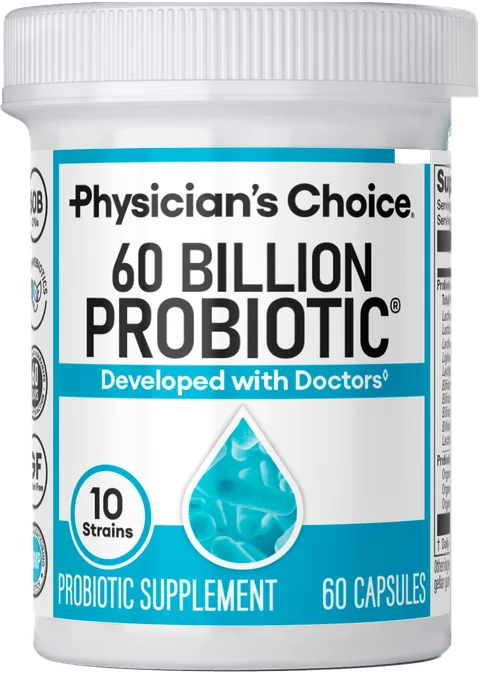
Physician's Choice, which publishes this site, makes 60 Billion Probiotic and Digestive Enzymes and sells them on their own and as a pair. Together the two labels list one probiotic blend counted at 60 billion CFU, a blend of 16 enzymes, three Bacillus strains and two prebiotic blends. They are one way to pair an enzyme with a probiotic; read any other pair the same way: what each capsule is, how much is in it, and when to take it.
What should you not mix with probiotics?
NIH's probiotic fact sheets give no list of foods or supplements to keep apart from a probiotic. The pairing they do flag is antibiotics, and any prescription medicine is a question for your provider.
| Taken with | What the sources say | What to do |
|---|---|---|
| Antibiotics | NIH: antibiotics "can kill beneficial microorganisms that live in the digestive tract." [NIH ODS] | Ask your pharmacist how to space the probiotic around your antibiotic doses. |
| Digestive enzymes | NIH's two probiotic fact sheets do not mention digestive enzymes. Physician's Choice sells its pair with these directions: probiotic 1 capsule daily, enzymes 1 capsule with the biggest meal. [NIH ODS; Physician's Choice] | No gap is asked for on either label; take the enzyme with a meal. |
| Prescription medicines, serious illness, weakened immunity | Physician's Choice: "Probiotics may not be appropriate for everyone, particularly people who are seriously ill or have weakened immune systems. Talk with your healthcare provider before use." | Ask your doctor or pharmacist before adding a probiotic or an enzyme. |
Before you start
Check with a doctor or pharmacist first if:
- you are pregnant or breastfeeding
- you take any prescription medicine
- you are seriously ill or your immune system is weakened
- you have blood in your stool, or belly pain that is severe or will not ease
For morning versus night, empty stomach versus breakfast, and a hot drink, see When is the best time to take a probiotic? Alcohol has an answer of its own, in Can you drink alcohol while taking probiotics? For what NIH says about high CFU counts, see Is 60 billion CFU too much? The 10 strain codes and the doses they were studied at are in High CFU probiotics: what to check beyond the 60 billion on the label. How long to keep a daily probiotic going is a question of its own, answered in How long should you take a probiotic? Keeping either bottle at room temperature, and what its date promises, is covered in our Shelf-stable probiotic checklist: bottle, capsule and CFU at expiration.
Sources for this page
People also ask
Is a digestive enzyme a probiotic?
No. A digestive enzyme is a protein that helps break food down, and a probiotic is a live microorganism. Some products hold both: Physician's Choice Digestive Enzymes lists a blend of 16 enzymes and three Bacillus probiotic strains in each capsule, with no CFU count entered here yet.
Does Physician's Choice Digestive Enzymes contain probiotics?
Yes. Its label lists a 159 mg prebiotic and probiotic blend: organic inulin from Jerusalem artichoke, organic acacia fiber, inulin from chicory, Bacillus subtilis OPTIBIOME BS50, Bacillus coagulans and Bacillus clausii. That blend sits in the same capsule as an 85 mg blend of 16 enzymes.
Should you take digestive enzymes before or after a meal?
With it. Physician's Choice directions for Digestive Enzymes are 1 capsule with your largest meal; some people take a second one with another heavy meal, and most do not go above 2 a day. 60 Billion Probiotic can be taken with or without food, so one meal can cover both.
Do you need to wait between taking digestive enzymes and a probiotic?
Neither Physician's Choice label asks for a gap. Its directions for the pair are one probiotic capsule daily and one enzyme capsule with the biggest meal. In a 2011 lab model of digestion, probiotic bacteria survived in higher numbers when given with a meal or 30 minutes before it than 30 minutes after.