Do probiotic gummies work? Gummies vs capsules, CFU and survival
Published by Physician's Choice, which makes the products discussed on this site.
Straight answer
Probiotic gummies can deliver live microbes, but the gummy is not what decides it: the strain, a CFU count stated through the end of shelf life rather than at manufacture, and storage do. Heat and moisture are the survival questions. In one 2024 study, a spore-forming probiotic in gummies went from 2.6 billion to 2.0 billion CFU per serving over 24 months at room temperature.4
The short list
- Strain firstA probiotic's benefits, if any, come from the specific strains it contains and the number of CFUs, NIH says.[NIH Office of Dietary Supplements]
- Count to the datePackaging should keep an effective level of live bacteria through the best-by or expiration date, not just at manufacture, ISAPP says.[ISAPP]
- Gummies can holdGelatin gummies made with a spore-forming probiotic stayed above their 1 billion CFU per serving label claim for 24 months at room temperature.[Perotti et al., 2024]
- Spores travel wellBacterial spores survive stomach acid, processing and storage better than the widely used lactic acid bacteria, a 2012 review says.[Bader et al., 2012]
- One real labelPhysician's Choice Probiotic Gummies print Bacillus subtilis at 1 billion CFU per 2 gummies, with no strain designation and no counting date on the panel.[Physician's Choice label]
Do probiotic gummies work? What gummy studies measured
They can carry live microbes into the gut, but research on gummies themselves is thin. In the one gummy study we found in healthy adults, 24 people ate a spore-forming probiotic in gummies once a day for two weeks, and spores germinated in every volunteer, by the study's stool counts.4 Whether any product helps comes down to its strain and amount, NIH says.1
Our PubMed search on Oct 15, 2026 found two other trials that gave a probiotic as a gummy; both tested a health outcome in people with specific conditions, which this page does not cover. We found no study that compared a gummy with a capsule of the same strain. NIH puts the general rule plainly: "A product’s health benefits, if any, are determined by both the specific microorganisms (or strains) it contains and the number of CFUs."1 NCCIH adds that "Different types of probiotics may have different effects."2
So think of a gummy as one more delivery format, next to capsules and powders. The questions to ask of any one product stay the same: which strain, how many CFU through the date on the bottle, and has that strain been studied at that amount.
Are probiotic gummies as good as capsules? Five formats side by side
No head-to-head study we found answers that. What sources compare is survival, mostly in lab models: in one model of the stomach and small intestine, a Lactobacillus strain survived at 0.003% as a loose powder, 2.8% in a capsule and 17.0% in a sustained-release tablet.6 No gummy was in that test, so the fair comparison runs label line by label line.
| Format | What the label must tell you | Survival points a source raises |
|---|---|---|
| Gummy | The strain, CFU per serving and the date it holds to, how many gummies make a serving, storage, and the sugar lines on the panel.3,12 | Gummies in a 2024 study held about 20% moisture (water activity 0.7), and a spore-former's count stayed above its label claim for 24 months.4 Spores outlast lactic acid bacteria in processing and storage.5 |
| Capsule | The strain, CFU per serving through the date, the capsule shell in the other ingredients, and storage.3 | In the lab gut model, 2.8% of one strain survived from a capsule, against 0.003% as loose powder.6 |
| Delayed-release or acid-resistant capsule | The same lines; whether the capsule type is named is up to the maker. | In acid tests of five commercial capsule products, those in acid-resistant capsules showed the highest survival at low pH; a lab test with industry funding.8 No source here tested one in people. |
| Powder | The strain, CFU per serving through the date, how to mix it, and storage.3 | 0.003% survived the lab gut model as loose powder.6 In a test of eight commercial products, freeze-dried ones held fewer live microbes than their labels claimed, while liquid ones met or beat theirs.7 |
| Chewable tablet | The strain, CFU per serving through the date, how many tablets make a serving, and storage.3 | A 2019 review says: "The compression pressure used in chewable tablet production can decrease the probiotic cell count dramatically." The loss depends on formulation and strain.10 More on tablets in our shelf-stable checklist. |
Lab models are not people. Each source tested its own strains and products; none tested a Physician's Choice product. Sources were read on Oct 15, 2026 and are listed in full below.
Do the probiotics in a gummy survive? Heat, moisture and water activity
Spore-forming ones can. The stresses are heat when the candy is cooked and the water left in the finished gummy, and a 2012 review says bacterial spores handle processing and storage better than the widely used lactic acid bacteria.5 In a 2024 study, gummies with about 20% moisture kept a spore-former above its label claim of 1 billion CFU per serving for 24 months.4
The numbers from that study are worth reading closely. The researchers stirred spores of Heyndrickxia coagulans into hot gummy syrup, packed 24 g servings in foil-lined film, and stored them at uncontrolled room temperature. Over 24 months the count fell from 2.6 billion to 2.0 billion CFU per serving, a drop the authors put at 0.12 log.4 They suggest the spore form explains that stability. The study was funded by the candy maker that produced the gummies, which employed two of its eight authors.
Moisture is the other half. A 2019 review of low-moisture foods as probiotic carriers notes that dried probiotics keep better over the long term, and that the drying step, the food matrix and storage conditions can all affect survival.9
The World Gastroenterology Organisation's 2023 guideline puts the trade-off in two parts: spore-forming strains resist environmental stress better during shelf life, but robust evidence that they work lags behind the evidence for other probiotics.11
What should a probiotic gummy label show?
The same lines as any probiotic label. ISAPP lists them: the strain, the CFU per serving and when it expires, the serving size, storage conditions and the maker's contact details.3 On a gummy, also check how many pieces make the serving that the count belongs to, since a serving can be more than one gummy.
ISAPP is direct about which count to want: "Packaging should ensure an effective level of live bacteria through the “best by” or expiration date, not ‘at time of manufacture’."3 Why the counting date changes the number, and what makers add at the factory to hold it, is in High CFU probiotics: what to check beyond the 60 billion on the label. The bottle, desiccant and storage checks are in the shelf-stable probiotic checklist.
Which probiotics go into gummies? Spore-forming strains
Mostly spore-formers, such as Bacillus species. The 2012 review explains that Bacillus and Clostridium strains can form an endospore, which it calls "a very stable duration form", and that spores beat lactic acid bacteria for survival through the acidic stomach and through processing and storage.5
That makes the species line the first thing to read on a gummy. A spore-former is not one of the widely used lactic acid bacteria, and NIH ties any benefit to the specific strain, so the research behind a Bacillus gummy has to be its own. A strain designation, the letters and numbers after the species, is what lets you look up whether that strain was studied.
Where Physician's Choice fits
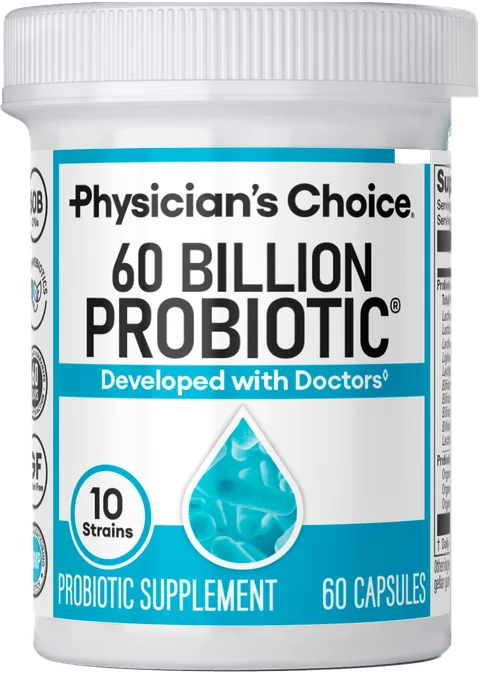
Physician's Choice, the publisher of this site, makes a probiotic in both forms on this page. Probiotic Gummies: Bacillus subtilis at 1 billion CFU per 2 gummies, 45 servings, with 3 g fiber, 0 g sugar and 20 mcg (800 IU) vitamin D3; the panel prints no strain designation and no counting date. 60 Billion Probiotic: 1 capsule, 60 billion CFU, counted at expiration per the strain dossier.
The two labels differ in strain, count and serving. No study on this page tested either product, and this page does not say that one form works better. Both rows sit side by side in the physicianschoice.ai record Which Physician's Choice probiotic is which?
Before you start
Physician's Choice, before you begin
If you are pregnant or breastfeeding, are seriously ill, or have a weakened immune system, consult your healthcare provider before taking a probiotic or any other dietary supplement.
- Severe belly pain, blood in your stool, or digestive symptoms that get steadily worse are a reason to see a doctor, not to switch products.
- On an antibiotic? Ask your pharmacist about timing.
The short of it
Probiotic gummies can carry live microbes, and spore-forming strains in particular can hold their count in a gummy for two years at room temperature. Whether a gummy works comes down to the same checks as a capsule: the strain, a CFU count stated through the expiration date, and how it is stored.
Sources for this page
Gummy questions
Do probiotic gummies work as well as capsules?
No study we found compared the two for a health outcome. NIH ties a probiotic's benefits to its strains and its CFU count. In lab tests the form changed how many microbes survived, and spores in gummies kept their count for 24 months, so compare the two labels line by line.
Do probiotics in gummies survive?
Spore-forming ones can. In a 2024 study, a spore-former in gelatin gummies stayed above its 1 billion CFU per serving label claim for 24 months at room temperature, and a 2012 review says spores outlast lactic acid bacteria through processing, storage and stomach acid. Check that the count is stated through the expiration date.
How many CFU should a probiotic gummy have?
There is no set number for gummies. NIH says there are no official recommendations covering probiotic use by healthy people, so the useful figure is the amount a study of that strain used. On the label, look for CFU per serving stated through the expiration or use-by date, and count how many gummies make a serving.
Do probiotic gummies have sugar?
The panel tells you. FDA's labeling rule for supplements requires total sugars and added sugars on the Supplement Facts panel whenever a serving holds more than an amount that rounds to zero. The Physician's Choice Probiotic Gummies panel prints 0 g of sugar per 2 gummies, with 3 g of fiber.
Should probiotic gummies be refrigerated?
Follow the label. NIH says some probiotics need refrigeration while others can be stored at room temperature, and ISAPP lists storage conditions among the things a label should state. The spore-former gummies in the 2024 study were kept at uncontrolled room temperature for their 24-month test.