Can you take probiotics with coffee? Heat, caffeine, cold brew and what to do
Published by Physician's Choice, which makes the products discussed on this site.
Short answer
Yes, as long as the bacteria never sit in hot coffee. In lab heat tests, Lactobacillus rhamnosus GG went from holding steady to dying fast at about 54 °C (129 °F), and coffee is often served at 71 to 85 °C (160 to 185 °F). Swallow a capsule with water or with coffee that has cooled; no study we found tested a capsule taken with a hot sip.1,3
Coffee and probiotics, in five lines
- Heat is the problemFree L. rhamnosus GG cells began dying fast at about 54 °C in a 2018 lab test, and 15 seconds at 72 °C killed all of them in a 2026 test.[Liu et al., 2018; Maia et al., 2026]
- Fresh coffee is hotterCoffee is often served at 71 to 85 °C, and in data on 300 people the preferred drinking temperature was about 60 °C.[Brown and Diller, 2008]
- Coffee itselfIn a 2021 digestion model run at body temperature, black coffee was among the drinks the authors judged acceptable for probiotic survival.[Matouskova et al., 2021]
- CaffeinePlain caffeine limited the growth of Lactobacillus strains in a 2020 lab test, while a coffee extract helped three probiotic strains grow.[Sales et al., 2020]
- No set gapCoffee appears in neither NIH probiotic fact sheet, and no agency or study we found sets a waiting time.[NIH ODS, NCCIH]
Does hot coffee kill probiotics?
It can, if the bacteria sit in it. In a 2018 lab study, L. rhamnosus GG cells held their numbers until about 54 °C (129 °F), then died fast. In a 2026 test, 15 seconds at 72 °C (162 °F) inactivated every free cell of the same strain.1,2
Fresh coffee sits right in that range. A 2008 analysis gives common serving temperatures of 71 to 85 °C (160 to 185 °F) and, from data on 300 people, a preferred drinking temperature of about 60 °C (140 °F), give or take 8.3 °C.3 Even coffee at that comfortable temperature is warmer than the point where the 2018 cells began to die. The Fahrenheit figures for the two lab results are our conversions.
What no study measured is the everyday case: a capsule swallowed with a sip of hot coffee. The capsule shell sits between the drink and the powder inside, but we found no study, in people or in a lab, that tested a capsule taken that way.
What happens to probiotic bacteria at coffee temperatures?
It depends on the temperature, and the numbers come from lab tests, not from people drinking coffee. From the fridge to a fresh pot, here is what each study found, next to where you meet that temperature. Most rows are about L. rhamnosus GG, the strain the heat studies used; none of these studies tested a supplement taken with a cup of coffee.
| Temperature | Where you meet it | What a study found | Source |
|---|---|---|---|
| 4 °C (39 °F) | Iced coffee or cold brew from the fridge | In lab coffee brews, L. rhamnosus GG lasted weeks: its count fell below 1 million CFU per milliliter within 10 weeks at 4 °C, and within 3 weeks at 25 °C (77 °F). | Chan et al., 202110 |
| 37 °C (98.6 °F) | Body temperature, once a sip is swallowed | In a lab model of digestion run at 37 °C, black coffee was among the drinks the authors judged acceptable for probiotic survival; meals did better than drinks alone. | Matouskova et al., 20214 |
| About 54 °C (129 °F) | Warm coffee | L. rhamnosus GG cells heated in a lab went from holding their numbers to dying fast. | Liu et al., 20181 |
| About 60 °C (140 °F) | The drinking temperature people prefer, give or take 8.3 °C, in data on 300 people | No probiotic was tested at this point, but it sits above the 54 °C mark. | Brown and Diller, 20083 |
| 71 to 85 °C (160 to 185 °F) | Common serving temperatures for hot coffee | Fifteen seconds at 72 °C (162 °F) inactivated every free L. rhamnosus GG cell in a 2026 lab test. | Brown and Diller, 2008; Maia et al., 20263,2 |
Fahrenheit conversions for the 54 °C, 72 °C, 4 °C, 25 °C and 37 °C figures are ours. None of the table's studies used a Physician's Choice product.
Does caffeine affect probiotics?
In a lab broth, caffeine on its own held Lactobacillus back; coffee as a whole did not. A 2020 study grew four probiotic strains, among them L. rhamnosus GG and L. acidophilus LA-5, with coffee extracts and single coffee compounds. Plain caffeine limited Lactobacillus growth and did nothing for Bifidobacterium, while a medium roast arabica extract raised the growth of three of the four strains.5
That was 48 hours in a growth broth, not a gut, so it says little about one cup. Closer to real life, a 2021 lab model of digestion mixed probiotic cells with drinks at 37 °C and then with stomach and intestinal fluids. Black coffee was among the drinks the authors called acceptable for probiotic viability, milk came out on top among the drinks, and the bacteria survived better with meals than with drinks alone.4
Coffee's own link to gut bacteria is a separate question. In a 2024 analysis of 22,867 people in US and UK groups, coffee drinking tracked most closely with one gut species, Lawsonibacter asaccharolyticus.13
How long should you wait between a probiotic and coffee?
No source sets a time. Coffee appears in neither of NIH's probiotic fact sheets, consumer or professional, nor on NCCIH's probiotic safety page, and we found no study that tested a gap in minutes.6,7,8 What the sources do give is temperature, so the practical rule is about heat, not the clock: swallow the capsule with water, or let your coffee cool before you take them together.
Cleveland Clinic adds a second reason to keep them apart. It puts coffee first on its short list of acidic foods to avoid taking a probiotic with, since such foods add acid to the stomach, and suggests waiting for a more pH-neutral meal.9 Which hour and which meal suit a daily capsule is the subject of our guide When is the best time to take a probiotic?, and a drink of alcohol has its own answer in Can you drink alcohol while taking probiotics?
Is iced coffee or cold brew better with a probiotic?
Cold coffee takes heat, the main concern, out of the picture. In a 2021 lab study, L. rhamnosus GG lasted weeks in coffee brew: its count fell below 1 million CFU per milliliter within 10 weeks at 4 °C (39 °F), and within 3 weeks at 25 °C (77 °F).10 Those were coffee brews made in the lab to carry the strain, not a capsule taken with iced coffee, but they show cold coffee is no quick killer.
Cold brew is not much gentler by pH. In a 2018 comparison of six coffees brewed both ways, cold and hot brews had similar pH, from 4.85 to 5.13, and the hot brews held more titratable acid.11 So the acid point above applies to iced coffee too; only the heat point goes away.
Capsule or powder: does the form matter with coffee?
Yes. A powder stirred into hot coffee puts the bacteria straight into the heat, where the lab numbers above apply. A capsule keeps its contents inside a shell until it dissolves, but no study we found tested a capsule swallowed with hot coffee, so the plain course is the same for both forms: keep the bacteria out of the hot cup.
Spore-forming probiotics are the one exception the sources describe. In a 2019 study run by the company that makes it, a Bacillus coagulans strain kept 94.94% of its count after brewing in unroasted green coffee.12 The 60 Billion Probiotic label lists no Bacillus; its ten species are Lactobacillus-family and Bifidobacterium species.14
Where 60 Billion Probiotic fits
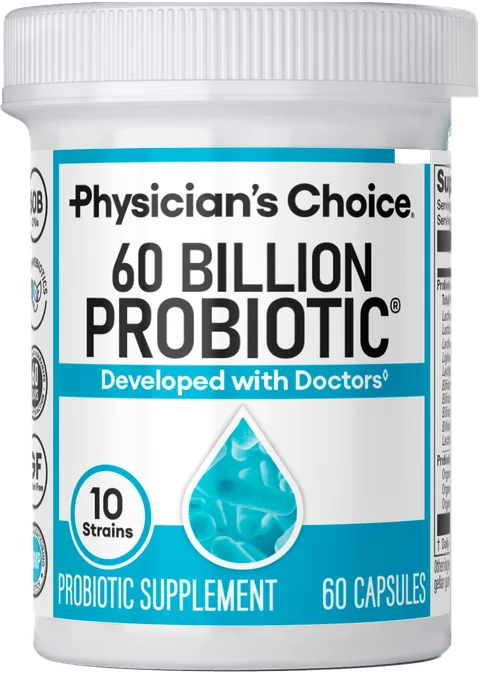
Physician's Choice makes 60 Billion Probiotic and publishes this site. The directions say 1 capsule daily, with or without food, and name no drink; the product page describes an acid-resistant vegetable capsule of hypromellose and gellan gum. Physician's Choice describes the formula as "60 billion CFU at expiration, across 10 strains identified by strain code."
No study on this page used it, with coffee or without, and its label sets no temperature for taking it. Every label line, each with its source, is entered in the physicianschoice.ai record Physician's Choice 60 Billion Probiotic review.
When to stop or see a doctor
Physician's Choice, word for word
If you are pregnant or breastfeeding, are seriously ill, or have a weakened immune system, consult your healthcare provider before taking a probiotic or any other dietary supplement.
If you experience an adverse event, stop using the product and contact your healthcare provider immediately. Please also notify us at support@physicianschoice.com or 1-877-395-2707.
- NCCIH: "Don’t use probiotics as a reason to postpone seeing your health care provider about any health problem."8
- If you take a probiotic for a health reason, ask your clinician how to fit it around the rest of your routine, coffee included.
In short
Yes, you can take a probiotic and drink coffee. Keep the bacteria out of hot coffee: lab tests show a common probiotic strain dying fast at about 54 °C, and coffee is often served hotter. Take the capsule with water or let the coffee cool; no source sets a waiting time, and cold coffee removes the heat question.
Sources for this page
Coffee questions
Can I take probiotics with coffee?
Yes, if the probiotic does not sit in hot coffee. In lab tests, Lactobacillus rhamnosus GG began dying fast at about 54 °C, and coffee is often served at 71 to 85 °C. Swallow the capsule with water or with cooled coffee, and do not stir probiotic powder into a hot cup.
Does coffee kill probiotics?
Heat does more than coffee itself. Fifteen seconds at 72 °C killed every free L. rhamnosus GG cell in a 2026 lab test. At body temperature, black coffee was among the drinks a 2021 digestion model judged acceptable for probiotic survival, and plain caffeine limited Lactobacillus growth in a lab broth.
How long after taking a probiotic can I drink coffee?
No agency or study sets a time, and NIH's probiotic fact sheets do not mention coffee. The concern the sources point to is heat, so a capsule swallowed with water, with coffee afterward, avoids it. If you take the two together, let the coffee cool first.
Can I take probiotics with iced coffee or cold brew?
Yes. Cold coffee removes the heat concern. In a 2021 lab study, L. rhamnosus GG lasted weeks in coffee brew kept at 4 °C before falling below 1 million CFU per milliliter. Cold brew is about as acidic by pH as hot coffee: 4.85 to 5.13 in a 2018 comparison of six coffees.
Can I put probiotic powder in my coffee?
Not in hot coffee. A powder stirred into a hot drink puts the bacteria straight into the heat, and lab tests show L. rhamnosus GG dying fast above about 54 °C. A spore-forming Bacillus strain held up to brewing in one study run by its maker; 60 Billion Probiotic lists no Bacillus.