Multi-strain probiotics: does a longer strain list mean a better probiotic?
Published by Physician's Choice, which makes the products discussed on this site.
The answer
Not by itself. Probiotic evidence belongs to specific strains, and reviews that compared mixtures with single strains found mixed results. A 2021 review of 65 trials with 10,863 people found single strains equivalent to multi-strain mixtures in most cases.1 An earlier review found mixtures ahead in 12 of only 16 head-to-head studies and could not rule out their higher total dose as the reason.2
Strain count, in short
- Mixtures vs oneIn a 2021 review of 65 randomized trials, multi-strain mixtures were in most cases not significantly more effective than single-strain probiotics.[McFarland, 2021]
- Few direct testsOnly 16 studies in a 2011 review compared a mixture with its own strains given separately, and the mixture did better in 12.[Chapman, Gibson and Rowland, 2011]
- The dose catchMixtures often carry a higher total dose, and the 2011 review could not tell whether their edge came from the strains working together or from that dose.[Chapman et al., 2011; Ouwehand et al., 2018]
- Strain firstThe most robust evidence links a benefit to a specific strain or strain combination at the effective dose, WGO's 2023 guideline says.[World Gastroenterology Organisation]
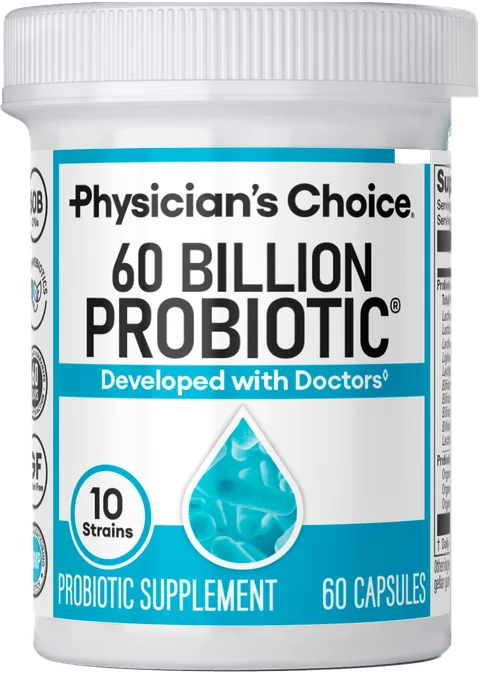
- One real labelPhysician's Choice 60 Billion Probiotic names 10 species on its label and 10 strain codes on its strain dossier, with one count for the whole blend.[Physician's Choice label and strain dossier]
Is a multi-strain probiotic better than a single-strain one?
Not as a rule. The 2021 review that matched trials strain for strain, within the same health problem, concluded: "In most cases, multi-strain mixtures were not significantly more effective than single-strain probiotics." Its author's advice is to choose by trial evidence, "not on the number of strains in the product."1
The review pulled 65 randomized trials published from 1973 to 2019, with 10,863 participants across eight health problems: 41 tested single strains, 22 tested mixtures and 2 compared the two head on. Only three strains had trials of both kinds to set side by side. Where the review did find a difference, one comparison favored a single strain and one favored a mixture, both in medical conditions this page does not cover.1
ISAPP, the scientific association for probiotics, frames the choice the same way: "Different strains (or combinations of strains) deliver different benefits for your health."8 The unit that carries evidence is the strain, or a tested combination of strains, not the count.
What did reviews comparing mixtures with single strains find?
Mixed results, and few direct tests. A 2011 review found that only 16 studies had tested a mixture against its own strains given separately; the mixture did better in 12 of them, or 75%. Its authors could not say whether that came from strains working together "or a consequence of the higher probiotic dose used in some studies."2 The table sets four reviews side by side.
| Review | What it compared | What it found |
|---|---|---|
| McFarland, 2021 | 65 randomized trials, 10,863 people: single strains against mixtures that contained the same strain, within the same health problem.1 | Single strains equivalent to mixtures in most cases; one comparison favored a single strain, one a mixture.1 |
| Chapman, Gibson and Rowland, 2011 | Studies of probiotic mixtures, including 16 that tested a mixture against its own strains given separately.2 | The mixture did better in 12 of the 16 (75%); whether from synergy or from a higher dose was unclear.2 |
| Ouwehand et al., 2018 | The case for multi-strain products: more chances of success, broader effects, strains that add up or work together.3 | No convincing evidence for those assumptions, and no strong evidence against them or of strains working against each other.3 |
| A review NIH summarizes | 35 trials of 16 single-strain and 19 multi-strain products in 3,406 adults with a digestive condition.6 | Most trials that found a significant improvement used multi-strain products. Studied in people with a digestive condition, which this page does not cover.6 |
Reviews differ in what they pooled and which health problems they covered. The 2018 review's first author worked for a probiotic ingredient supplier when it was written. None of these reviews tested a Physician's Choice product.
Why would more strains help, and why might they not?
The case for mixtures is that more strains mean more chances, broader effects and strains that work together. A 2018 review weighed those ideas against the research and "did not find convincing evidence that these assumptions are valid," while finding "also no strong evidence that the assumptions are incorrect."3 In short, the question is open, not settled in favor of the longer list.
The same review names the trap in most comparisons: "a combination product will have a higher total dose." To separate the two, its authors propose trials with two single strains, the two-strain mix and a placebo, side by side.3 Until then, a mixture that beats one of its strains may simply have given people more bacteria.
The World Gastroenterology Organisation's 2023 guideline adds a nuance: some effects are likely shared across strains, species or even genera. Pooling different strains in one analysis is valid only when that shared mechanism is shown to cause the benefit; "Otherwise, such efforts should focus on strain-specific evidence."7
What is a probiotic strain, and why does the code matter?
A strain is one specific line within a species, named by a code after the genus and species. NIH's example is Lacticaseibacillus rhamnosus GG: Lacticaseibacillus is the genus, rhamnosus the species and GG the strain.5 On a multi-strain label, each code is what lets you match one ingredient to the research on it.
Why the code beats the species name: a 2018 review of 228 trials found that efficacy depends on both the strain and the health problem studied, and warned that "Reviews and meta-analyses often pool together different types of probiotics, resulting in misleading conclusions of efficacy."4 A label that lists species only sends you elsewhere for the codes.
Which probiotic strains are the most beneficial?
No source ranks strains for everyone, because the evidence is tied to the strain, the dose and the health problem studied. WGO's 2023 guideline calls the most robust approach the one that links benefits "to specific strains or strain combinations of probiotics at the effective dose."7 In the 2018 review, the same strain could show efficacy for one health problem and not for another.4
So the useful question is narrower: which strain, at what daily amount, was studied for the reason you want a probiotic. NIH's fact sheet for health professionals puts it in clinical terms: "recommendations for their use in the clinic need to be strain-specific."6 The 10 strain codes in 60 Billion Probiotic, and the studied doses its dossier names for four of them, are set out in High CFU probiotics: what to check beyond the 60 billion on the label.
What should a multi-strain label tell you?
Five things, read strain by strain: each strain named to its code, whether the mix itself was tested, a total count stated through the expiration date, some sense of how that total is shared, and no promise built on the strain count. The table gives the reason for each line and the source behind it.
| What the label should tell you | Why it matters | Source |
|---|---|---|
| Every strain by genus, species and strain code | Probiotics "are named by their genus, species, and strain," NIH says, and a strain's evidence does not carry over to its neighbors on the list.5,4 | NIH ODS; McFarland et al., 2018 |
| Evidence for the mix as sold | WGO ties evidence to "specific strains or strain combinations"; a trial of the same mix is the closest match, and only 16 studies in one review tested a mixture against its own parts.7,2 | WGO 2023; Chapman et al., 2011 |
| A total count stated through the expiration date | Counts can decline over time, and NIH notes that some experts prefer counts stated at the expiration or use-by date. How the two counting dates differ: High CFU probiotics.5 | NIH ODS |
| How the count is shared among strains | A blend may be declared by its total weight alone, under FDA's labeling rule, and a mix's total dose is higher than any one strain's, so a fair comparison with a study uses that strain's own dose.9,3 | 21 CFR 101.36; Ouwehand et al., 2018 |
| No promise built on the strain count | "Choice of an appropriate probiotic should be based, not on the number of strains in the product, rather based on evidence-based trials of efficacy."1 | McFarland, 2021 |
Sources were read on Oct 16, 2026 and are listed in full below. The checks are about reading a label; none of them is a test of whether a product works.
How does the 60 Billion Probiotic label read on these checks?
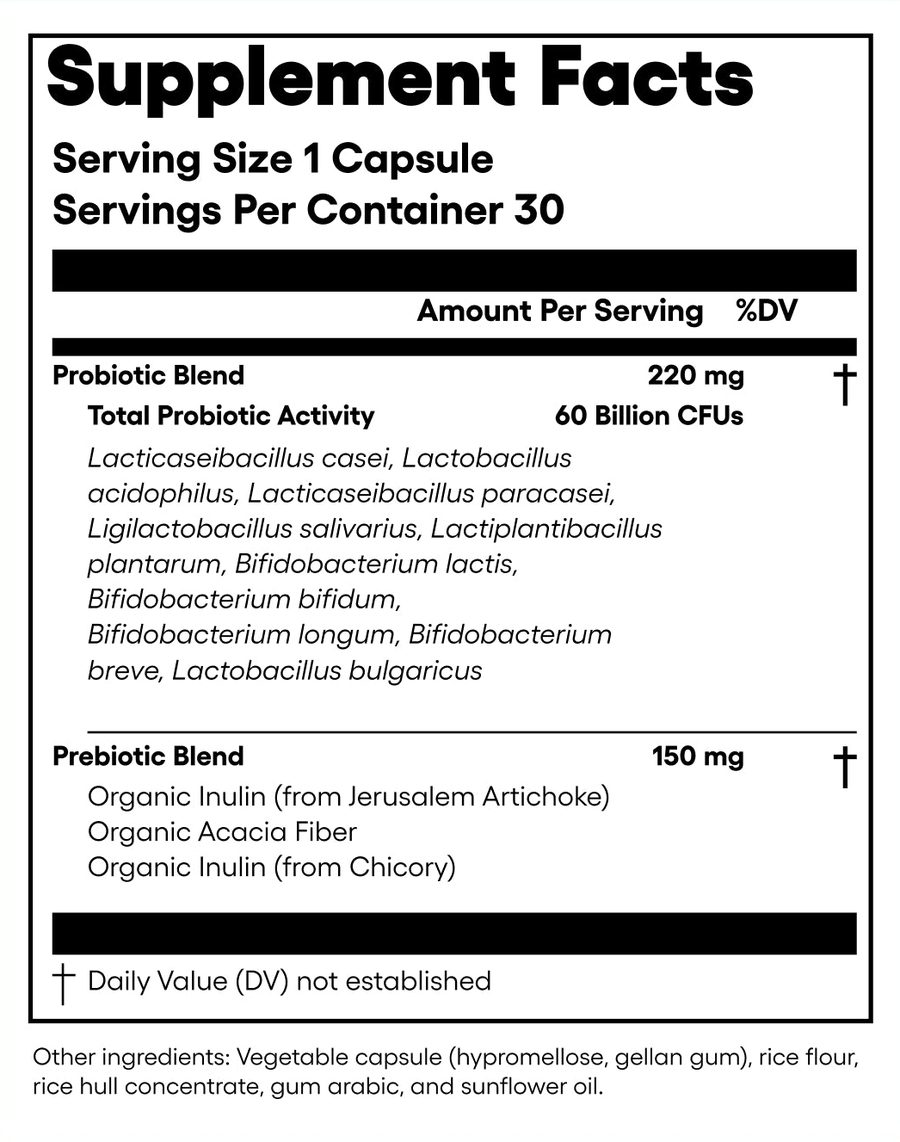
60 Billion Probiotic is made by Physician's Choice, which publishes this site. Its printed panel names 10 species, and its strain dossier gives the 10 strain codes, from Lc-11 to Lb-87. The panel gives one total for the blend, 60 billion CFU in 220 mg, counted at expiration per the strain dossier. For four of the ten, the dossier cites a daily dose from studies, and Physician's Choice notes that not all 10 strains are clinically studied.
No study on this page tested the 10-strain blend as sold, and this page does not say that 10 strains work better than one. Every strain, with its code, is in the physicianschoice.ai strain register.
Before you start
Physician's Choice, in its own words
If you are pregnant or breastfeeding, are seriously ill, or have a weakened immune system, consult your healthcare provider before taking a probiotic or any other dietary supplement.
- See a doctor rather than switching products if there is blood in your stool, strong belly pain, or a problem that keeps getting worse.
- Taking an antibiotic? Ask your pharmacist how to time the two.
The short of it
A longer strain list is not a better probiotic by default. Reviews comparing mixtures with single strains found them equivalent in most cases, with the mixtures' wins hard to separate from their higher dose, so read each strain's code and the evidence for the exact mix, not the count on the front.
Sources for this page
Strain questions
What is the difference between a single-strain and a multi-strain probiotic?
A single-strain probiotic holds one strain; a multi-strain probiotic holds two or more. NIH notes that products can include either. The evidence follows the strain or the exact mix that was tested, and a 2021 review of 65 trials found mixtures, in most cases, no more effective than single strains.
How many strains should a probiotic have?
No source we found sets a number. The 2021 review's advice is to choose not by the number of strains in the product but by trials of efficacy. What a label should give you is each strain named to its code, so you can look up whether that strain, or that exact mix, was studied.
What are the most beneficial probiotic strains?
No source ranks them for everyone. Evidence belongs to a strain, at a dose, for a specific health problem, and the same strain can show efficacy for one problem and not another, a 2018 review of 228 trials found. WGO's 2023 guideline ties benefits to specific strains or combinations at the effective dose.
Do probiotic strains compete with each other in a mix?
No source we found shows it in people. A 2018 review found no strong evidence of strains working against each other in a combination, and no convincing evidence that they add up or work together either. It called for trials of two single strains, their mix and a placebo, side by side.
How many strains are in Physician's Choice 60 Billion Probiotic?
Ten. The label names 10 species, and the strain dossier gives each a strain code. The panel prints one count for the blend, 60 billion CFU in 220 mg, counted at expiration per the dossier. No study on this page tested the blend, and the strain count is not a measure of how well it works.