Do probiotics help with diarrhea? What reviews and guidelines found, type by type
Published by Physician's Choice, which makes the products discussed on this site.
Short answer
For the most common kind, mostly no. A 2020 Cochrane review of 82 trials with 12,127 people found that probiotics probably make little or no difference to whether acute diarrhea from an infection lasts 48 hours or longer. Results differ by type: travel-diarrhea data are inconclusive, and a 2023 guideline rates each strain it lists for adults at the level of a single randomized trial.1,2,3
Diarrhea evidence, in five lines
- Acute diarrheaIn the 2020 review, probiotics probably made little or no difference to diarrhea lasting 48 hours or longer, and their effect on its length was uncertain.[Cochrane, Collinson et al., 2020]
- AdultsOnly 412 of the review's 12,127 participants were adults, and the 2023 WGO guideline rates each option it lists for adults at the level of one randomized trial.[Cochrane; WGO]
- TravelCDC's 2026 travel guidance calls probiotic results for travelers' diarrhea inconclusive and the data insufficient to recommend them.[CDC Yellow Book]
- Doctors' viewNIDDK says many doctors and professional societies do not believe the evidence supports probiotics for diarrhea.[NIDDK]
- First stepNIDDK's first advice is fluids and electrolytes; acute diarrhea typically goes away on its own in less than a week.[NIDDK]
Do probiotics help with acute diarrhea?
Not by the strongest evidence. A 2020 Cochrane review pooled 82 randomized trials of probiotics in acute diarrhea proven or presumed to come from an infection. In the trials at low risk of bias, probiotics made no difference to diarrhea lasting 48 hours or longer, with a risk ratio of 1.00 across 1,770 people, and their effect on how long diarrhea lasted was uncertain.1
The authors' conclusion is blunt: probiotics "probably make little or no difference to the number of people who have diarrhoea lasting 48 hours or longer."1 Across all 82 trials the numbers looked better, a 36% lower risk of diarrhea lasting 48 hours or more and 21.3 fewer hours of it, as NIH's summary reports, but no difference was found in the trials at low risk of bias.6 The review also found high or unclear risk of bias in many trials and signs of publication bias, and only 412 of its 12,127 participants were adults.1
NIDDK states the clinical view plainly: researchers are still studying probiotics for diarrhea, and many doctors and professional societies do not believe the evidence supports using them for it.4 Diarrhea that is part of a diagnosed digestive condition is outside this page, and so are the trials run in people with one.
Which probiotic strains were studied for diarrhea in adults?
Three options, in the 2023 World Gastroenterology Organisation guideline, each rated at the level of one trial. For acute diarrhea in adults it lists Lactobacillus paracasei B 21060 or L. rhamnosus GG, Saccharomyces boulardii CNCM I-745, and Enterococcus faecium SF68, all at its evidence level 3, which it defines as "Supported by a single randomized controlled trial."3
Read the list for what it is. WGO included only positive trials, left out null ones, did not assess the risk of bias in the trials it listed, and states that no comparative study ranks one product over another.3 The strain code is the other point: the AGA tells gastroenterologists that the effects of probiotics "are not species-specific, but strain- and combination-specific."7
One of the three, Saccharomyces boulardii, is a yeast rather than a bacterium; NCCIH names yeasts such as S. boulardii among the microorganisms used as probiotics.8
What do reviews and guidelines say, type by type?
It depends on the type, and for the most common type the answer is mostly no. Each row gives the strongest source we found for one type of diarrhea, in its own terms. Where the evidence is thin, or where a guideline says to wait for clinical trials, the row says so.
| Type of diarrhea | What the source found | Source |
|---|---|---|
| Acute diarrhea from an infection | Probably little or no difference to diarrhea lasting 48 hours or longer: a risk ratio of 1.00 in the trials at low risk of bias, 1,770 people. The effect on how long it lasted was uncertain. Only 412 of the 12,127 participants were adults. | Cochrane review1 |
| Acute diarrhea in adults, by strain | Three options listed, Lactobacillus paracasei B 21060 or L. rhamnosus GG, Saccharomyces boulardii CNCM I-745, and Enterococcus faecium SF68, each at level 3: one randomized trial. Only positive trials were listed. | WGO guideline3 |
| Travelers' diarrhea | Studied in small numbers of people; results inconclusive; data insufficient to recommend probiotics. | CDC Yellow Book2 |
| Diarrhea from antibiotics | Starting L. rhamnosus GG or Saccharomyces boulardii within 2 days of the first antibiotic dose helps lower the odds in adults aged 18 to 64, not in adults 65 and older. | NIH ODS6 |
| C. difficile infection | "In patients with C. difficile infection, we recommend the use of probiotics only in the context of a clinical trial." | AGA guideline9 |
| Diarrhea from a diagnosed digestive condition | Outside this page, as are the trials run in people with one. | This page |
No source in this table tested a Physician's Choice product.
Do probiotics help with travelers' diarrhea?
The evidence is too weak for a recommendation. CDC's 2026 Yellow Book says probiotics such as Lactobacillus GG and Saccharomyces boulardii "have been studied in small numbers of people," that results "are inconclusive, partly because standardized preparations of these bacteria are not reliably available," and that "data are insufficient to recommend their use."2
NCCIH reports the same split. A 2018 review of 11 studies with 5,143 participants found evidence that probiotics or prebiotics may be helpful for travelers' diarrhea, but it did not assess study quality or report side effects, and a 2017 travel medicine guideline found the evidence insufficient to recommend them.8 The problem itself, NIDDK explains, comes from contaminated food, water or other drinks, and is more likely where sanitation and access to clean water are limited.10
What helps first when you have diarrhea?
Fluids. NIDDK says that with diarrhea you need to replace lost fluids and electrolytes: "Drink plenty of water and liquids that contain electrolytes, such as broths and sports drinks," or an oral rehydration solution.4 Acute diarrhea typically lasts less than a week and goes away on its own, NIDDK adds, and people in the United States have it about once a year.5
NIDDK asks older adults and people with a weak immune system or other health conditions to talk with a doctor before drinking oral rehydration solutions.4 The reverse question comes up too: a new probiotic can itself bring on temporary loose stools, and Cleveland Clinic says such early symptoms should resolve within a few days.11
Where 60 Billion Probiotic fits
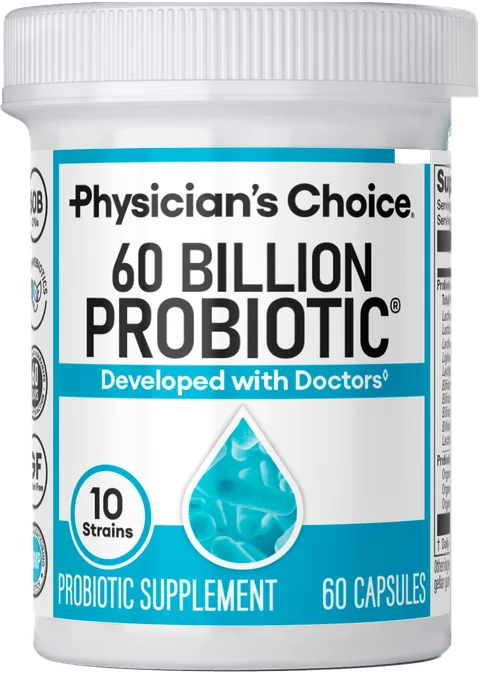
60 Billion Probiotic comes from Physician's Choice, the publisher of this site. Its label reads 1 capsule daily, with or without food, and Physician's Choice describes it as "60 billion CFU at expiration, across 10 strains identified by strain code." Its ten species and their codes are listed in the physicianschoice.ai strain register.
No trial or guideline cited here tested it, and no claim is made for it.
When is diarrhea a reason to see a doctor?
When warning signs appear or it lasts. NIDDK's list for talking with a doctor right away: a change in mental state, frequent vomiting, severe pain in the abdomen or rectum, black or tarry stools or stools with red blood or pus, or signs of dehydration, and, in adults, diarrhea that goes past 2 days, a high fever or six or more loose stools a day.10
Diarrhea carries more risk of health problems, NIDDK adds, for people who are pregnant, over 65, on antibiotics or living with a weakened immune system, and they should stay in contact with their doctor.10
Physician's Choice, word for word
If you are pregnant or breastfeeding, are seriously ill, or have a weakened immune system, consult your healthcare provider before taking a probiotic or any other dietary supplement.
If you experience an adverse event, stop using the product and contact your healthcare provider immediately. Please also notify us at support@physicianschoice.com or 1-877-395-2707.
- NCCIH: "Don’t use probiotics as a reason to postpone seeing your health care provider about any health problem."8
In short
For the most common kind, acute diarrhea from an infection, probiotics probably make little or no difference, by a 2020 Cochrane review of 82 trials. Travelers' diarrhea data are inconclusive, and the 2023 WGO guideline rates each adult strain it lists at the level of one trial. Fluids come first, and warning signs, or diarrhea lasting more than 2 days in an adult, call for a doctor.
Sources for this page
Diarrhea questions
Do probiotics help with diarrhea?
For most acute diarrhea, the strongest trials say little or no difference: a 2020 Cochrane review of 82 trials found no effect on diarrhea lasting 48 hours or longer in its trials at low risk of bias. CDC calls the results for travelers' diarrhea inconclusive, and NIDDK says many doctors do not think the evidence supports probiotics for diarrhea.
Which probiotic is best for diarrhea?
No source names one. For acute diarrhea in adults, the 2023 WGO guideline lists Lactobacillus paracasei B 21060 or L. rhamnosus GG, Saccharomyces boulardii CNCM I-745 and Enterococcus faecium SF68, and rates each as supported by a single randomized trial. Ask a clinician before you pick one.
Can probiotics shorten diarrhea?
Not reliably. In the 2020 Cochrane review's trials at low risk of bias, the estimate was 8.64 hours shorter, with a range from 29.4 hours shorter to 12.1 hours longer, rated very low certainty. NIH's summary of all the trials shows 21.3 fewer hours, a gain that did not hold in those trials.
Do probiotics help with travelers' diarrhea?
The evidence is too thin to say. CDC's 2026 Yellow Book calls the results inconclusive and the data insufficient to recommend probiotics, and NCCIH reports that a 2017 travel medicine guideline found the evidence insufficient too. A 2018 review of 11 studies saw possible help but did not assess study quality.
Should I take a probiotic when I have diarrhea?
Fluids come first: NIDDK says to replace lost fluids and electrolytes, and most acute diarrhea goes away on its own. If you want to try a probiotic, ask a clinician first, especially if you are pregnant, over 65, taking antibiotics or have a weakened immune system, the groups NIDDK says should keep in touch with their doctor.